Work no. 69
Umbrian workshop
Architectural reliquary
First half of the 16th century (1540?)
Embossed, chased and gilt copper; engraved silver; glass
- Inscriptions
- YHS (foot and knop); PARTE DELLA COSCIA DI SANTO BENEDETTO MARTIRE (entablature of the receptacle); 17 (small dome); S. EUTIZIO (label under the foot)
- Place of recovery
- Preci, Piedivalle, Museum of the Abbey of Sant’Eutizio (recovered on 24 November 2016)
- Provenance
- Norcia, Ancarano, Church of San Benedetto
- Current location
- Spoleto, Santo Chiodo Cultural Heritage Operations Centre
- Restoration and safety work
- Safety work: Santo Chiodo Cultural Heritage Operations Centre, Spoleto, OPD 2019, 2026
About the work
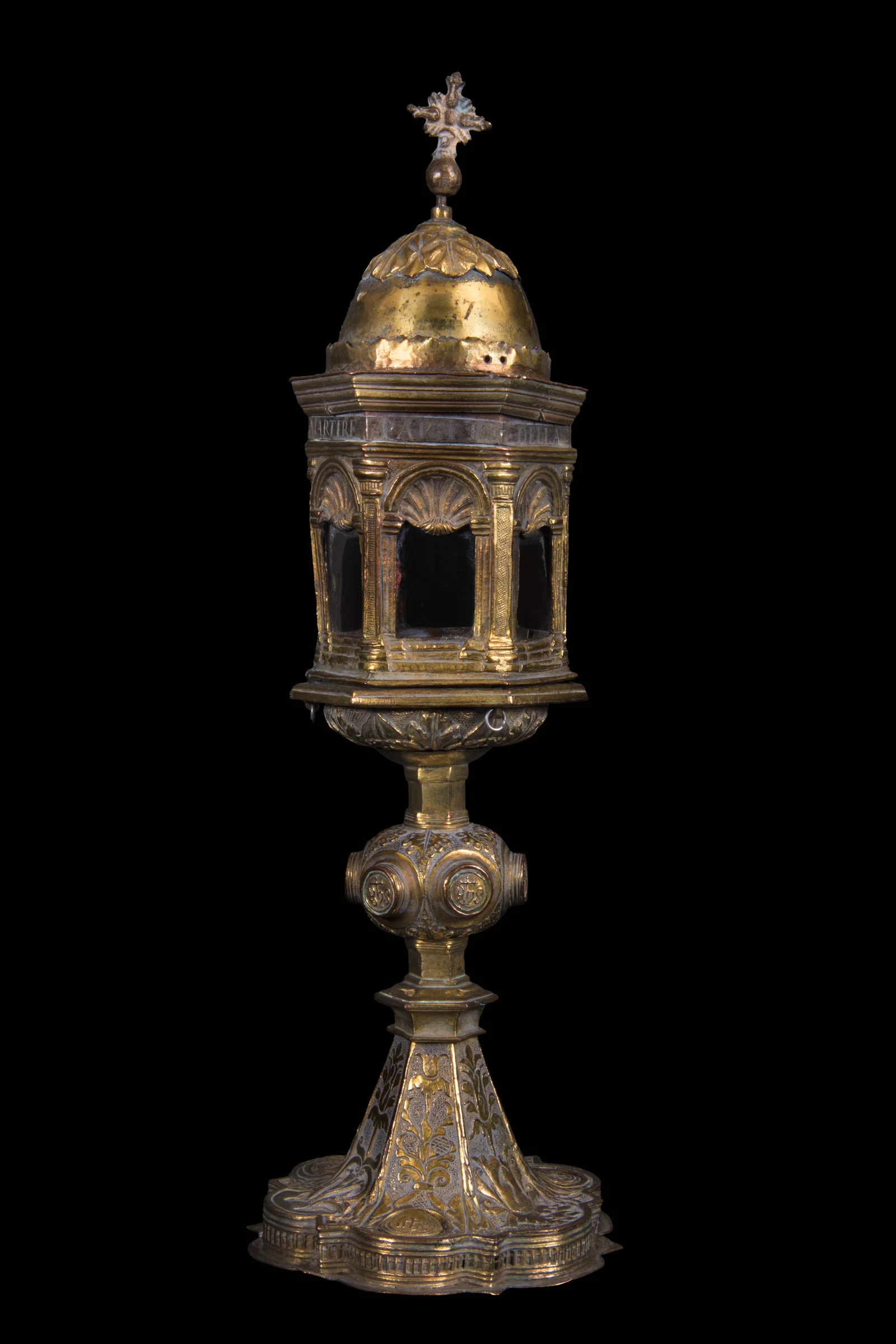
This architectural reliquary consists of a six-lobed foot alternating with points, with a raised central band carrying an openwork pattern formed by a series of small round arches; the upper surface of the foot is divided into six fields filled with dense engraving, from which rise candelabra ornaments springing alternately from varied flower clusters and from embossed roundels bearing the monogram of Jesus Christ. One of the three circular plaques is set between a pair of dolphins. The hexagonal stem has a flattened spherical knop decorated with multi-lobed leaves and six bezels, where the plaques with the Christological monogram recur. From the stem rises the receptacle, a hexagonal temple resting on an engraved calyx embossed with acanthus and lanceolate leaves; the small windows of the case, which no longer contains its relic, each frame a shell within a round arch and alternate with corner pilasters. The temple is crowned by a small dome with a cap of overlapping leaves, set on an entablature between moulded cornices and carrying an inscription. The receptacle ends in a reused rayed cross with a floral design, on a globe.
Although the object still keeps a Gothic-derived structure in the lobed and pointed foot and in the knop with bezels, other elements clearly draw on the Renaissance repertoire, such as the candelabra and animal motifs of the foot and the structure of the receptacle. Here the usual Gothic temple with mullioned windows, gables and pinnacles is abandoned for good in favour of an architecture in the new classically inspired style, with the shell-shaped hoods of the windows recalling architectural and sculptural models of the second half of the fifteenth century. Comparison with the reliquary from the church of San Giorgio in Cascia, by an Umbrian workshop of the early sixteenth century, shows similarities in the structure of the foot and stem and in the decoration, while the upper part is markedly different in form – enough to suggest that the original receptacle was replaced with the present one. It should be borne in mind, however, that Gothic schemes and Renaissance forms often coexist in the sacred goldsmiths’ work made between the fifteenth and sixteenth centuries, and the combination recurs in other sixteenth-century Umbrian reliquaries (besides the one from San Giorgio, those of San Giovenale in Logna, San Felice in Colle di Avendita and San Francesco in Terni). Another open question concerns the small dome, whose belonging to the rest of the object is doubtful, while the small cross at the top is clearly a later addition. The provenance from the church of San Benedetto in Ancarano, Norcia, rests on Ansano Fabbi’s Preci e la Valle Castoriana, where the author describes the object as a temple-shaped monstrance, dates it to 1540 (without citing a source) and illustrates it in a photograph with other pieces of goldsmiths’ work. In transcribing the inscription under the dome, which he describes as engraved and nielloed, Fabbi gives the text QUI MANDUCAT HUNC PANEM VIVET IN AETERNUM, which differs from the one now legible on the plate and would in fact identify the piece not as a reliquary but as a monstrance. The Christ monogram on the roundels would also fit that use. At present nothing is known about when the inscription recorded by Fabbi might have been replaced, which would therefore have happened relatively recently.