The project
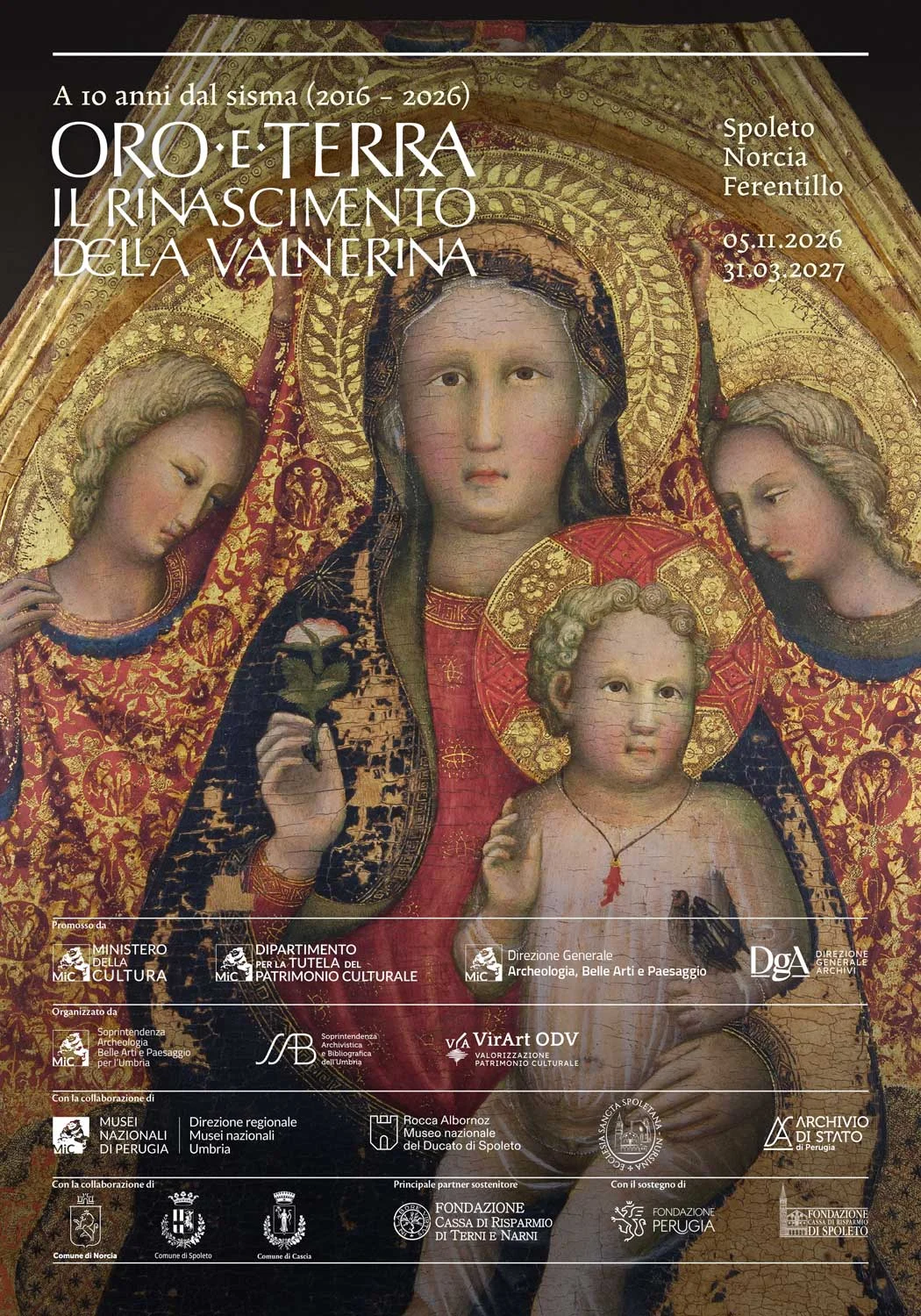
Ten years after the earthquake that struck a vast area of the central Apennines, Oro e terra. Il Rinascimento della Valnerina is a multi-site exhibition of art history and documents that returns to their places and communities more than 170 objects – works of art, archival documents and books – recovered and restored after the 2016 earthquake, thanks to the work of the Superintendencies that protect this heritage and make it accessible. It is also the story of one of the largest operations to protect cultural heritage ever carried out in Europe after a natural disaster.
From Spoleto, the hub of the project and the gateway to the Valnerina, the exhibition extends to Norcia, Ferentillo, Cascia, Arrone and Vallo di Nera. On Friday 30 October 2026, ten years after the earthquake, Norcia – one of the epicentres, where the Basilica of San Benedetto collapsed – hosts a preview focusing on some of the objects in the exhibition; on 5 November the venues in Spoleto and Ferentillo open. The exhibition runs until 31 March 2027.
An invitation to travel through the Valnerina
The exhibition invites visitors to look again at the places where cultural heritage and communities have managed to regenerate, as living centres of rediscovery that counter the depopulation of inland areas: heritage becomes a reason for communities to stay and for people to visit.
It pays tribute to the people of the Valnerina and to everyone who contributed to the relief, protection, recovery and reconstruction efforts, and it tells the story of the heritage protection offices, which faced the emergency and the reconstruction in close cooperation with local institutions. Ten years after the earthquake, heritage protection gives back to communities not only the works that were saved, but a sense of historical and cultural continuity that no disaster can break.
Main venues, satellite venues and waymarks
The main venues – Rocca Albornoz – National Museum of the Duchy of Spoleto, the Diocesan Museum and the Basilica of Sant’Eufemia, the State Archives of Perugia – Spoleto Section, the Abbey of San Pietro in Valle in Ferentillo and, in Norcia, the Chapel of the Priors, the Council Hall and the Hall of the Forty Guardians of the Peace in the Town Hall – house most of the objects and documents.
The satellite venues extend the itinerary with small, focused displays – a few objects, books and documents – in the Basilica of San Benedetto in Norcia, at Palazzo Santi – Civic Museum and in the Church of San Francesco in Cascia, in the Church of Santa Maria in Vallo di Nera, in the Church of Santa Maria Assunta in Arrone, and in the “Giosuè Carducci” Municipal Library and the Santo Chiodo Centre for the Conservation of Cultural Heritage in Emergencies in Spoleto.
The waymarks are the places many of the objects on display come from, which are not accessible today: the Church of the Madonna Bianca in Ancarano, the Church of Sant’Antonio in Frascaro and the Church of San Salvatore in Campi, near Norcia; the Abbey of Sant’Eutizio in Piedivalle, the Church of Santa Maria della Pietà, the Church of San Martino in Abeto and the Church of San Bartolomeo in Todiano, near Preci. On this website each one has a page with its location, describing its history and culture and its condition since the earthquake.
The exhibition itinerary
- Rocca Albornoz, Spoleto. The itinerary begins at the Rocca with a section devoted to Nicola di Ulisse da Siena, one of the leading painters in the Valnerina in the mid-fifteenth century: the Renaissance images of the Abbey of Sant’Eutizio are brought together again for the first time in decades, reuniting the complete polyptych and the Rood Cross. A nearby room presents the Florentine works from the Valcastoriana and the Valle Oblita, including the Pietà by Piero di Cosimo. New highlights include the Saint Francis by Matteo Civitali, restored by the Opificio delle Pietre Dure, and an important group of sculptures: the Crucifix by Battista di Barnaba, the Madonna Bianca of Ancarano by Francesco di Simone Ferrucci and the two Crucifixes by Benedetto da Maiano, the one from Ancarano and its twin from Todiano, restored for the occasion. The section is completed by the Nativity by Domenico Beccafumi and, in the Barberini Chapel, the Madonna of Todiano by Giacomo di Giovannofrio, still bearing the marks of the earthquake, alongside the Saint Martin of Legogne by Giovanni Antonio da Lucoli and the Virgin Annunciate by Andrea della Robbia. Video projections collect the accounts of people who lived through the earthquake and helped to recover the works and rebuild, with a special focus on San Benedetto in Norcia.
- Sant’Eufemia, Spoleto. Alongside the Annunciation by the Norcia painter Francesco Fantone, from the Fondazione Carit, the core of this venue is Mannerist painting: on the high altar, the Crucifixion from Sant’Eutizio by il Pomarancio, next to the Saint Anthony Abbot by his pupil Giovan Battista Crescenzi, an early Crucifixion by Francesco Furini and the seventeenth-century altarpiece by Giacinto Brandi.
- Abbey of San Pietro in Valle, Ferentillo. A selection of the decorative arts: precious vestments and liturgical objects of the fifteenth and sixteenth centuries from some of the most important religious centres of the Valnerina, such as the Abbey of Sant’Eutizio, the “Ansano Fabbi” Collection and the Museo della Castellina in Norcia.
- Norcia. In the Town Hall, the sculptures of the Tardini family from San Giovanni in Persiceto, who moved to the Valnerina in the sixteenth century and filled the area with wooden works rich in gilded details; the Basilica of San Benedetto is newly arranged with works from its own decoration and with restored paintings and sculptures from other churches.
Documents and books
Throughout the itinerary, documents and books are shown alongside the works, placing them in their institutional, historical and economic context: among them, the parchments and paper documents of the Secret Archive of Norcia in their original wooden drawers; the Norcia copy of the Specchio dell’Ordine Minore, or Franceschina, by the Perugian Franciscan friar Iacopo Oddi, one of only five surviving copies; the illuminated liturgical manuscripts of the Abbey of Sant’Eutizio in Preci; and the bull with which Pope Boniface IX granted the Basilica of San Benedetto the perpetual privilege of a plenary indulgence.
The works, documents and books were restored and kept at the Santo Chiodo Centre for the Conservation of Cultural Heritage in Emergencies, in Spoleto, and at the State Archives of Perugia – Spoleto Section.
Promoters and organisers
The project was conceived and carried out by the Superintendency of Archaeology, Fine Arts and Landscape for Umbria and the Archival and Bibliographic Superintendency of Umbria, in collaboration with VirArt ODV, a non-profit association that promotes the cultural heritage of the area.
It is part of the programme of initiatives “Ten Years After the Earthquake (2016 – 2026)”, promoted by the Ministry of Culture with the Department for the Protection of Cultural Heritage, the Directorate-General for Archaeology, Fine Arts and Landscape and the Directorate-General for Archives.
The partners include the Regional Directorate of Museums of Umbria, the Archdiocese of Spoleto-Norcia, the State Archives of Perugia – Spoleto Section and the Municipalities of Cascia, Norcia and Spoleto.
Curated by
- Francesca Valentini, Superintendent of Archaeology, Fine Arts and Landscape for Umbria
- Caterina Fontanella, Archival and Bibliographic Superintendent of Umbria
- Alessandro Delpriori, researcher in Early Modern Art History at the University of Camerino
 (open the full-size image)